

The RAF have taken part in a number of US led strikes targeting Yemen’s Houthis after a warning to cease attacks on shipping in the Red Sea.
The highlight of the strikes was the RAF Typhoon FGR4, the most advanced version of the jet in the RAF fleet.
The RAF Typhoons took off from RAF Akrotiri base in Cyprus, supported by a Voyager air-refuelling tanker due to the the flight time of over 3000miles, not including the hovering over the targets prior to the strikes.
The Typhoon FGR4 is truly a bombing specialist with its Paveway Guided bombs, along with an internal 27mm Mauser cannon. The Typhoon can carry the Advanced Short-Range Air-to-Air Missile (ASRAAM); the beyond-visual-range (BVR) ramjet-powered Meteor missile, also used by Indian Air Force’s Rafale fighters; the AIM-120 Advanced Medium Range Air-to-Air Missiles (AMRAAM; Enhanced Paveway II and Paveway IV; Storm Shadow Air-Launched Cruise Missiles (ALCM) and Brimstone as air-to-ground weaponry.

The Typhoon got its first taste for combat during the 2011 military intervention in Libya with the RAF and the Italian Air Force, performing aerial reconnaissance and ground-strike missions.

With the retirement of the Tornado GR4 in 2019, the RAF commenced an upgrade programme that would eventually become Project Centurion to ensure that the Typhoon could take over the role of the Tornado GR4, providing precision strike duties. The Typhoon has become a formidable ground strike aircraft seeing combat also in Northern Iraq, using Storm Shadow missiles for the first time and the Paveway IV bombs during Operation Shader in Syria.
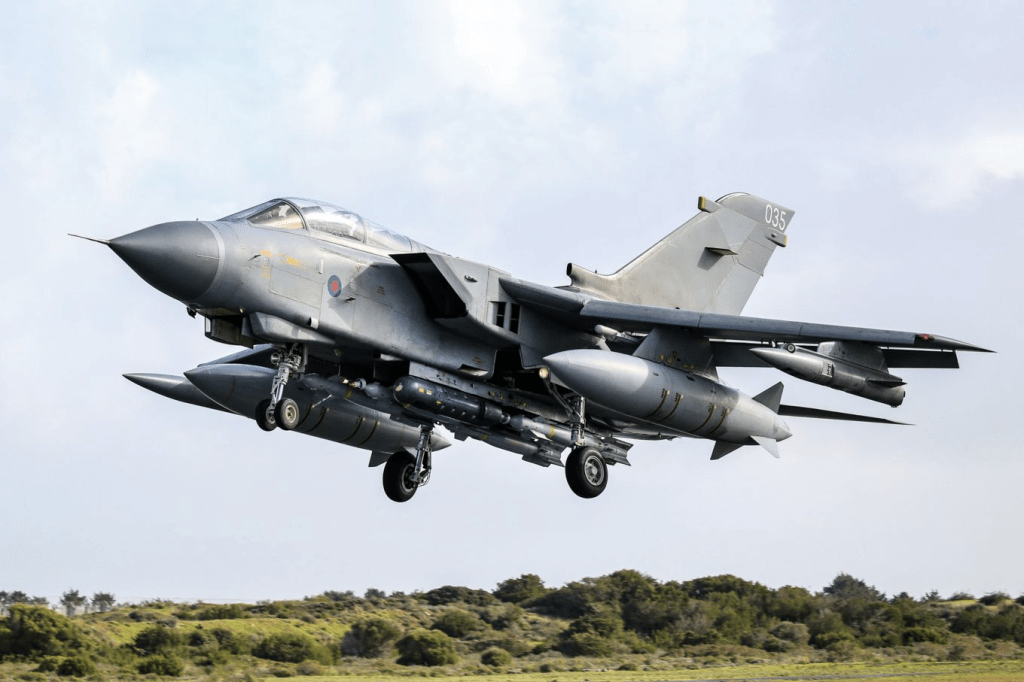
This weeks strikes on the Houthi’s in Yemen by the RAF Typhoons took out a number of targets using the Paveway IV guided bombs that weigh in at 226kg with a 45kg warhead in the middle which can penetrate the concrete, and a tail section that guides the bomb. It also uses a smart fuse to control how the bomb is detonated.
The bomb receives targeting coordinates when the (Paveway) is released, following which it interfaces with signals from GPS satellites and flies itself to a very accurate grid reference.
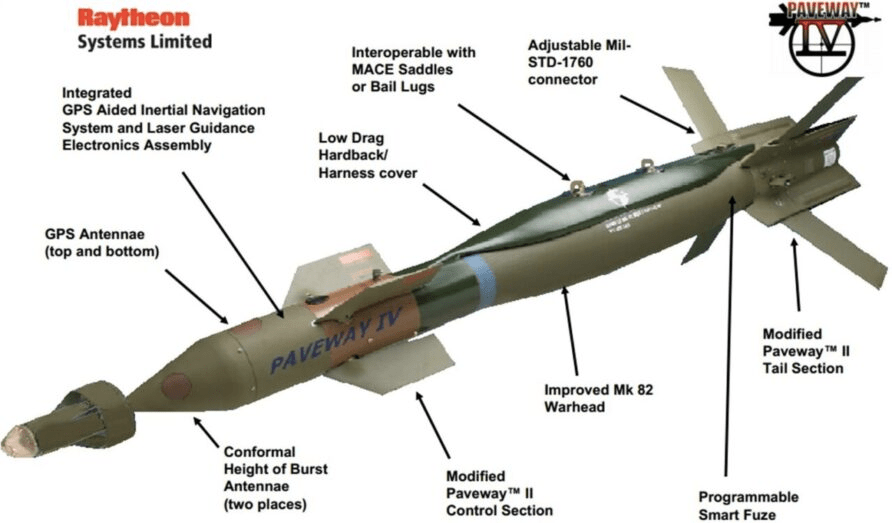
The Paveway IV is a dual-mode weapon, which means it can also be guided onto its target using a laser. A target will be illuminated by a laser, and the weapon will look for the reflected energy, homing in on the exact spot.
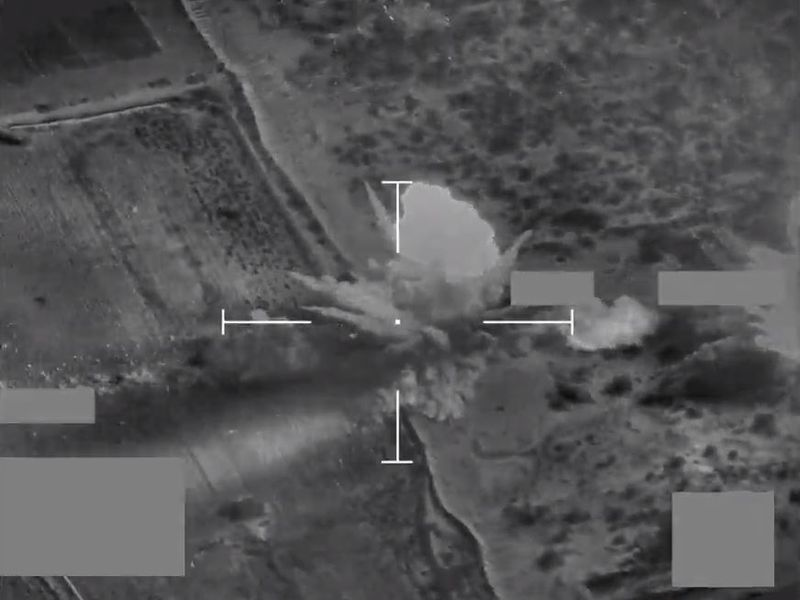
One RAF target was a group of buildings that were believed to have contained reconnaissance and attack drones at Bani in northwestern Yemen. The second RAF target was the airfield at Abbs, which intelligence had indicated was used to launch both cruise missiles and drones over the Red Sea.
The Typhoon FGR4 is a variant used by the RAF. This variant, primarily used by the Royal Air Force (RAF), is a sub-variant of the Tranche 2, Block 15 jets. The single-seat fighter is optimised for air-to-ground missions, reconnaissance, and multi-role operations.
It’s defining features are the Captor radar and PIRATE electro-optical targeting system. For ground-attack and close air support (CAS) missions, Typhoon is compatible with the GPS/laser-guided Enhanced Paveway II and Paveway IV bombs and Brimstone guided missile, usually in conjunction with the Litening III targeting pod.
Its regular configuration for the armed reconnaissance and CAS roles includes Litening III, Paveway IV, Brimstone, and the internal 27mm gun.
Paveway IV offers “cockpit-programmable impact angle, impact direction, and fuse delay features for precisely tailored target effects.” The 27mm gun is ideally suited to providing warning shots or for accurate attacks against targets, including light vehicles and personnel.
Impact on the Houthis
What damage the Typhoon strikes and US aerial bombing can do in Yemen to the Houthis depends upon how the Iran-affiliated group responds. The Ansarallah leadership (an alternative name for the Houthis) had been watching the British calls for intervention in Yemen for several days and must have significantly prepared for the eventuality to sustain the eventuality.
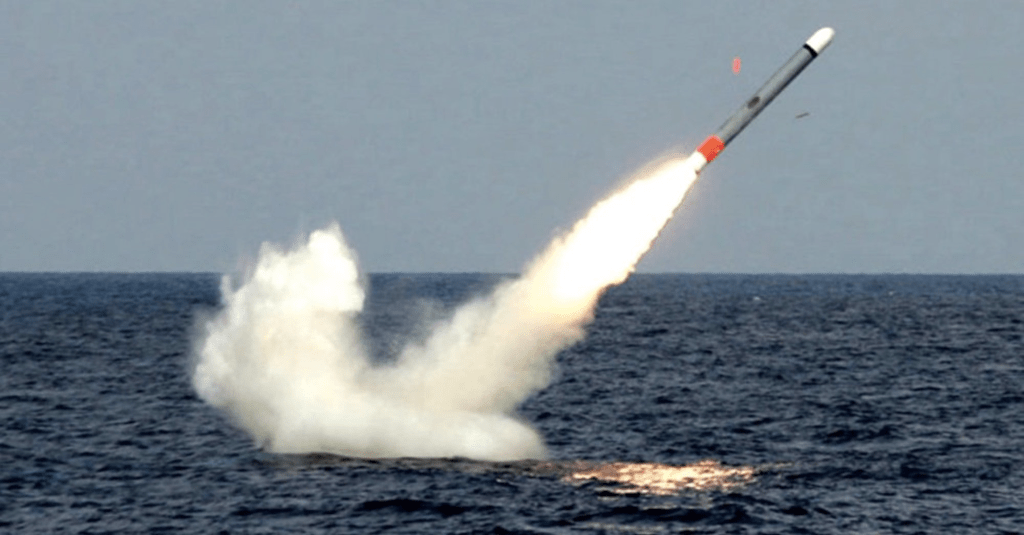
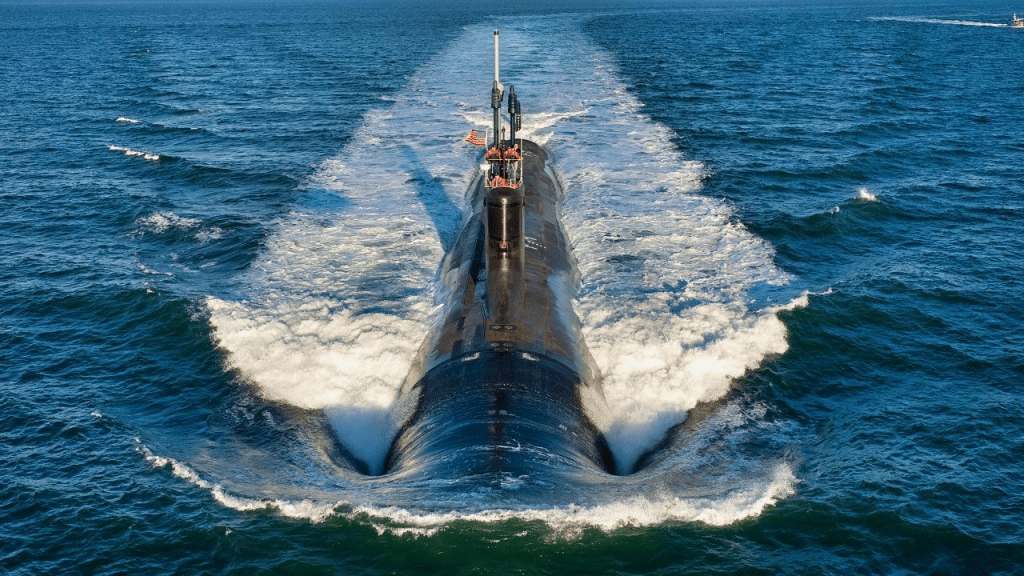
The joint strikes with the US hit more than “60 Houthi targets across 16 locations with more than 100 precision munitions of various types being deployed.” A considerable number of the 60 targets were also struck by missiles fired from coalition warships and submarines. Reports claim Tomahawk missiles were used.
The Houthis, like the Hamas, are not unaccustomed to operating under permanently hostile skies, especially after the Saudi and Emirati war on the southern Arabian nation. The conflict that began in 2015 caused the largest humanitarian crisis, displacing 4.5million people and one of the worst man-made famines faced by 6million Yemenis.
It is unlikely the Yemenis can effectively strike the naval task force unless they have sophisticated target acquisition, surveillance, and tracking capabilities. The group operates older models of Iranian drones and short-range ballistic missiles that don’t threaten modern warships.
American bases in the region are another matter entirely due to a lack of effective air defences and will be highly vulnerable to attack if this exchange of fire (and it is an exchange) continues to escalate.
Patarames, a leading Iranian military affairs commentator, pointed out that the Houthis are a completely “asymmetric” force with an atypical distribution of forces and assets, unlike conventional militaries.
“All important assets fit on a truck and are mobile. Most systems can be stored without further support systems and hence dispersed. No ‘volume systems’ like artillery with large ammo depots. No runways/ships/radar sites. Nothing central.”



 Military News Today
Leave a comment