Airbus Helicopters H125

The Airbus Helicopters H125, previously the Eurocopter AS350 Écureuil is a light single engine utility helicopter that first flew in June 1974. The H125 has been extremely successful both as a military helicopter and was previously operated by the British Military as a trainer. The Chinese have also developed a military support and light attack helicopter designated as the Z-11 which is largely based on the base designs of the H125. As a testament to the designs success, over 5,000 are currently in military and civilian service around the world.
QinetiQ operate a wide variety of types as part of the Empite Test Pilots school including four H125s. The ETPS was established in 1943 and was the first test pilots school in the world and has the motto “Learn to test, test to learn”. The H125s on strength with the ETPS have been modified to train pilots in a variety of different scenarios they may experience when testing experimental aircraft.
QinetiQ will be providing a number of aircraft for static display at this year’s Air Tattoo as part of our Pushing the Boundaries theme. This will include one of their Airbus Helicopters H125s.
Agusta A109

The AgustaWestland, previous Agusta, A109 is a lightweight twin-engine high-speed helicopter that first flew in August 1971. The A109 has been extremely successful both as a VIP helicopter but also as an Air Ambulance. Several military operators have also operated the A109 including Belgium who use the helicopter in the anti-tank role. Both the RAF and the Army Air Corps have both also operated the A109, the RAF continue to operate the type as a VIP helicopter and the Army used to operate the type as the primary transport for the SAS. A version of the A109 has been developed which uses Pratt and Whitney engines, this is called the A109E Power.
Since its privatisation, QinetiQ have become a world centre of excellence for research and development. QinetiQ also operate the Empire Test Pilots School who have trained over 1,500 students in its 80-year history. To support this, QinetiQ operate a fleet of modern training aircraft which, when not in use to train test pilots, they are used to support research and development activities. QinetiQ operate three A109’s – a pair of strengthened A109S variants and a single A109E Power.
QinetiQ will be providing a number of aircraft for static display at this year’s Air Tattoo as part of our Pushing the Boundaries theme. This will include their A109E Power.
Beechcraft King Air 350

The Super King Air 200 first flew in October 1972 and differed from the original King Air with larger fuselage and a high “T” tail. First deliveries of the Super King Air 200 also occurred in 1972 as the RU-21J for the US Army. In all, over 400 Super King Airs in various versions would be ordered for the US military under the common designation of C-12 Huron. The model 200 was further developed during the mid-1980s into the Super King Air 300 series which featured better aerodynamics and more powerful engines. This has been further developed into the King Air 350 (removing the Super) with a larger wingspan and longer fuselage. The Super King Air 200 was until recently used by the RAF as its multi-engine trainer and has now been replaced by the Embraer Phenom.
Since its privatisation, QinetiQ have become a world centre of excellence for research and development. QinetiQ also operate the Empire Test Pilots School who have trained over 1,500 students in its history, their motto being “Lean to test, test to learn”. To support this, QinetiQ operate a fleet of modern training aircraft which, when not in use to train test pilots, they are used to support research and development activities.
QinetiQ will be providing a number of aircraft for static display at this year’s Air Tattoo as part of our Pushing the Boundaries theme. This will include their brand new and heavily modified King Air 350i for its debut at RAF Fairford. The aircraft features an upgraded 5-bladed prop, provision for a retractable optics turret and is fitted with a belly pod for equipment together with external payload rails. QinetiQ’s King Air will be able to stay airborne for 10 hours at a time.
Westland Gazzelle HT2

The Aerospatiale Gazelle is a light single engine helicopter that was originally developed for the French Army as a replacement for the Alouette III. Since its first flight in 1967, over 1,700 have been built and the type has seen service in variety roles from light transport to battlefield scout to attack helicopter and as a trainer. The Gazelle has seen combat in numerous conflicts and was flown by both sides in the first Gulf War. The Gazelle is still in service with 23 nations today however it is slowly being replaced by newer types in specialised roles such as attack helicopter.
In the UK, the Gazelle remained in service with the Army Air Corps until late 2023 however prior to this, the type saw extensive service with the RAF, Royal Navy and Army Air Corps as a trainer. To the Army, it was an important anti-tank, observation and reconnaissance platform; it supported operations by Royal Marines Commandos; and the RAF even flew some as VIP transports. All of these roles are remembered by the ex-military Gazelles of the Gazelle Squadron Display Team, based near Wantage in Oxfordshire.
The Gazelle Squadron will be providing Gazelle HT2 XZ939 for static at this year’s Air Tattoo. This particular airframe was previously operated by QinetiQ for flight testing and for use by the Empire Test Pilots School, and therefore very relevant for our ‘Pushing the Boundaries in Air & Space’ theme.
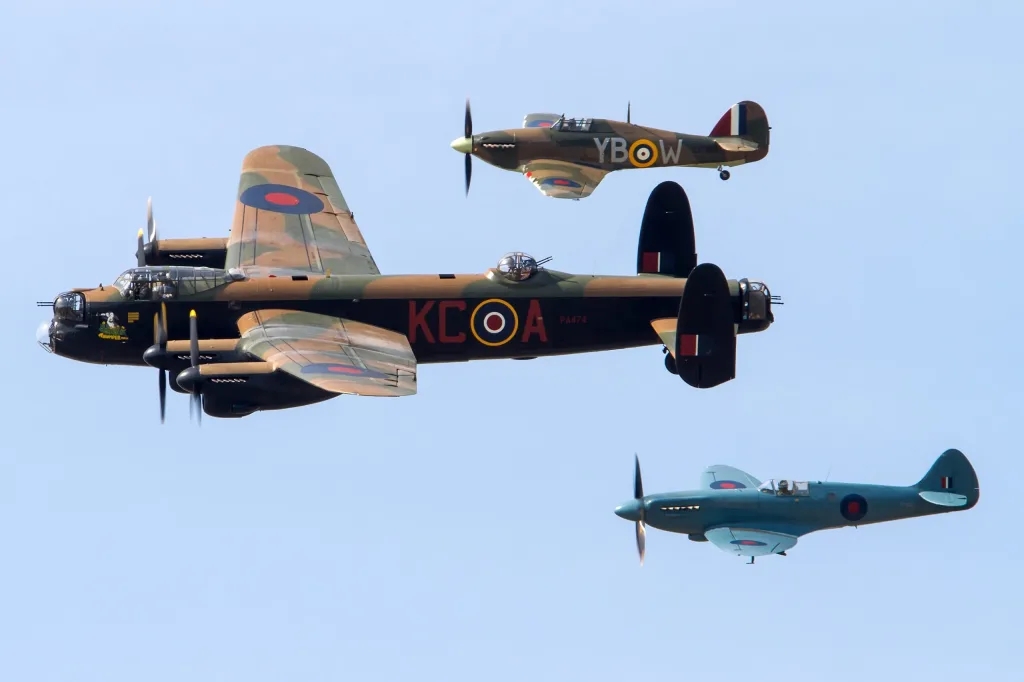
The Battle of Britain Memorial Flight

The Avro Lancaster was designed by Roy Chadwick, who also designed the legendary Avro Vulcan. The Lancaster was developed as a four engined heavy bomber and was based on the smaller yet visually similar Avro Manchester twin engined bomber. The Lancaster became famous for its long range and extremely heavy bomb load coupled with the ability to modified to carry special bombs such as the bouncing bomb and the Tall Boy/Grand Slam family of bombs used to sink the Turpitz. In all, over 7,377 Lancasters were built mainly serving with the RAF, RCAF and RAAF – 3,249 were lost in combat. Post war the Lancaster was often used for testing purposes but also saw short service as a transatlantic airliner called the Lancastrian. Today there are just two Lancasters left airworthy in the world, one with the RAF and the other is flown in Canada.
The Lancaster B.1 entered service during February 1942 with 44 Squadron at RAF Waddington and flew their first combat sortie during March deploying mines. The Lancaster formed part of a heavy bomber triad in RAF service alongside the Shorts Sterling and Handley Page Halifax, both of which had been produced to a similar specification. The Lancaster in RAF service is well known in popular culture for it’s role in the 1943 Operation Chastise by 617 Squadron to destroy the German Dams using unique bouncing bombs. A mission immortalised by the 1955 movie, The Dam Busters.
The Battle of Britain Memorial Flight will once again be displaying in the skies above RAF Fairford providing a living reminder of the sacrifice and heroism shown by RAF and Commonwealth pilots throughout the Second World War. Their Lancaster, PA474, was built in Chester in 1945 and was planned to be deployed to the Far East but never did see combat service. Following the war, the aircraft was used for reconnaissance duties before being used for trials work with new wing designs attached to the fuselage. Following restoration by 44 Squadron at RAF Waddington, PA474 was transferred in airworthy condition to the BBMF in 1973.
Saturday and Sunday this year will witness a rare five-aircraft display by the BBMF when the Lancaster will be joined by a pair of Spitfires and both of the BBMF’s Hurricanes. Friday will involve a more traditional three-aircraft flypast.



 Military News Today
Leave a comment